



Logo 1 Logo 2 Logo 3 Logo 4

All Stories

Inspiring Art -Inspiring Change

alt

SINGAPORE, 29th December 2012

One hundred talented young finalists of the ‘Celebrate the Sea’ children’s art competition gathered excitedly on the waterfront outside the SEA Aquarium in Resorts World Sentosa (RWS), Singapore. They had come, all buzzing with creative energy, to make their personal masterpieces on the theme of ‘One ocean’. With just three hours to complete their pictures, the short time frame and their tender years were clearly no obstacle to these young artists.

The children hunched over tables, faces flushed with concentration; working feverishly on their art and totally unaffected by the heat and humidity which was making the adults wilt. The range of their personal choices of medium was impressive, from crayon to watercolour to colouring pencils – with some using a combination of all three! The creative use of imagery and techniques in producing their work was so sophisticated it seemed they were beyond their years. All seven judges were astonished at the creativity and extremely high quality of the artwork produced.

This annual international children’s art competition, now in its 11th year, is held in conjunction with the Celebrate the Sea festival. This year there were over 3,000 entries in the preliminary round, with submissions coming from as far apart as Australia, Philippines, Indonesia, Singapore, Hong Kong, India and even Bulgaria.

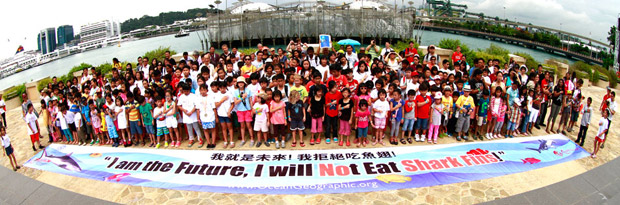
Due to obvious synergies, Ocean Geographic decided to combine this year’s competition with the powerful 1,000 Kids ONE Message event. Last year ‘1,000 Kids ONE Message’ was held for the first time in Hong Kong - 1,000 children gathered together in the heart of the shark fin consumer world to make a crucial pledge, “I am the future, I will not eat shark fins.” This year, it was decided that it would be held in Singapore and Marine Life Park, RWS was generous to host this event.

The Marine Life Park’s education team actively contributed to the day’s program by presenting an interactive, educational performance for the competitors, drawing squeals of excitement, laughter, ‘oohs’ and ‘ahhs’ from the children as live specimens (ranging from starfish to horseshoe crabs) were brought out for a visit.Mr Howard Shaw and Miss Jessica Tan (Miss Singapore/Universe 2007) also took to the stage to share their wonderful experiences of diving with sharks.

The children were given an opportunity to win prizes in a short quiz segment on sharks; a few were stumped for answers and were a little daunted by the audience! But no-one walked away empty-handed, since kind and helpful volunteers whispered answers into their ears so all were able to give the correct answers in the end and the audience learnt more about sharks into the bargain

After the results of the art competition were announced and the prizes collected by the very talented winners, the day ended with the finale – the taking of the pledge. Led by Miss Jessica Tan and Miss Debra Teng (local celebrity and actress), the children, together with supportive parents, gathered by the waterfront in the blazing sun to take the "I am the future, I will not eat shark fins" pledge in both English and Mandarin. 1,000 kids ONE message - we may have had 500 children not 1,000 this time, but whatever we lacked in numbers, these diners of the future made up for in heart.

Apart from the main messages of the day, if you could have seen how the children painted, how the judges struggled to differentiate between such incredible submissions and how quickly the kids absorbed facts during the interactive performance and quiz you would never again underestimate just how creative, artistic, intelligent, well read and outspoken our children are, and how much heart they have.


Children are our hope for healthier oceans (and as adults, we should lead them by example). This is a definitive campaign for children to both educate and inspire Singaporeans, communities all over Asia and the world beyond to protect these sentinel animals from extinction. 


Background:

Over 73 million sharks are culled each year for the shark fin trade and other shark-related products. This is unsustainable. Some sharks are already regionally extinct in the waters of South East Asia. Without them, the ocean will eventually collapse. Singapore is one of the biggest consumers of shark fins in Asia. As the regional centre for the shark fin trade, this project accentuates the solidarity of Singapore children, adults, and non-government organisations in one message, “I am the future, I will not eat shark fins”.

alt

Indonesia's Global Treasures by Michael AW wins major award


alt


Indonesia’s Global Treasures scores the PALME D'OR


Michael AW latest release ‘Indonesia’s Global Treasures’ has won the International Prize for Best Book of the Year at the World Underwater Pictures Festival (Festival Mondial de l'Image Sous Marine). This artistic book of the sea category yielded entries from a host of international authors and photographers including books published by media powerhouses from UK, Germany, Singapore, USA and France, but it is “Global Treasures” that received the Palme d'Or (Gold) award at the gala award ceremony of the world’s most prestigious underwater imagery festival of the ocean on 3rd November 2012 at Parc Chanot, Marseilles. Michael is the first author/underwater photographer to have won this prestigious award twice; the first was for “Heart of the Ocean” in 2009.

Save the Great White Sharks of Western Australia

alt

The Western Australian Government has recently announced new "shark mitigation" strategies, including plans to track and destroy sharks "if identified in close proximity to beachgoers". In response, the Ocean Geographic Society has drafted the following letter to the Premier of Western Australia, Colin Barnett.

Sign our petition here:
http://www.thepetitionsite.com/820/259/345/save-the-great-white-sharks-of-western-australia/

Attention to:
Honourable Colin Barnett MEc MLA
The Premier of Western Australia
 
We understand that your government is considering legislation to protect the locals and tourists from recent ill interactions with sharks.  In this instance, the board of directors and editors at Ocean Geographic Society and OceanNEnvironment Ltd Australia fervently express our concern of pre-emptive measures to cull sharks from coastal waters. Our views represent that of international scientific and conservation communities and also of Western Australian concerned stakeholders and ocean users, many of which are survivors and families of survivors of shark accidents.
 
Western Australia is globally recognised as one of the world’s leaders in conservation of the species of Great White shark. In Australia, the Great White Shark Carcharodon carcharias)  is listed as vulnerable and migratory under the Environment Protection and Biodiversity Conservation Act 1999 and globally it is listed in the  IUCN World Conservation Congress RED LIST as  Vulnerable A2cd+3cd ver 3.1 (http://www.iucnredlist.org/details/3855/0)
 
Sharks are apex predators, their roles are vital to keep the health of the ocean in balance. Sanctioning pre-emptive culling is a giant step backward in conservation and will bring ill reputation to Australia and your government.  Sanctioning pre-emptive culling will no doubt spawn off witch hunts and preposterous behaviour in local waters.
 
With the majority of Western Australians in favour of non-lethal shark protection programs, pre-emptively killing Great White Sharks is an extreme, excessive and a reckless response to ocean conservation. It is an erroneous representation of the views of Australians in general.
 
Researches have revealed that sharks routinely come close to humans without any incidents. While the culling a few sharks may seem inconsequential, the killing of endangered species listed in the IUCN Red list is disrespectful of nature and of the world’s populace. Homo sapiens are not on the endangered list.  The remaining population of Great While sharks are significantly low and the specie reproduces very slowly. 
 
Approved pre-emptive culling of the Great White will in fact bring a negative impact on nature based tourism.  Already potential visitors are expressing concern about the new legislation, indicating they may boycott Western Australia as a tourism destination if the pre-emptive kill policy is enacted. With the downturn in the mining industry protecting tourism from the negative image a cull would represent is more important than ever.
 
Instead of pre-emptive culling, we would like you to consider pre-emptive evacuation – ie if sharks are spotted within one kilometre of a beach or populated coastal water, immediate evacuation of the vicinity should be initiated. We are sure you can appreciate that sharks live in the ocean and it is humans that choose to put themselves at risk by visiting their domain.
 
Besides funding public warning and evacuation measures, please also consider research funding for better understanding and protection of this endangered animal. We hope you will respect the wishes of the majority of Western Australians, as well as the sentiments of a global community and protect Great White Shark Carcharodon carcharias)  for the wellbeing of our planet.
 
The Ocean Geographic Society
OceanNEnvironment Ltd – member of Environment Australia
 
Michael AW - PhD, Publisher, Ocean Geographic, Board Member, OceanNEnvironmet Ltd
David Doubilet & Jennifer Hayes - National Geographic Photographer in Residence
Howard Hall - Producer,  3D IMAX Coral Reef Adventure, Into the Deep
Michele Hall -  Producer,  3D IMAX Coral Reef Adventure, Into the Deep
Howard Latin - Phd, Distinguished Professor of Law and Justice Francis Scholar, Rutgers University
Emory Kristof - National Geographic Explorer in Residence
Gerry Allen - PhD, Conservation International
Amos Nachoum - Fellow Explorer Club, Professional Underwater Photographer
Christophe Lee - Snr Manager, Dept of Climate Change
Amanda Cotton - Wildlife Photographer
Lesley Rochat - Director, AfriOceans Conservation Alliance
Laurent Ballesta PhD - Naturalist, Film Producer, France
Stuart Ireland - Director, Calypso Productions
Howard Womersley - Underwater Photographer, divebuzz.com

Cabell Davis, PhD -  Chief Scientist, WoodsHole, Boston
Wyland - Artist for United Nation

Please show your support and add your name to the letter by signing our petition here:

http://www.thepetitionsite.com/820/259/345/save-the-great-white-sharks-of-western-australia/

No Shark Fins Singapore by 2013

alt


Post by Elena Lin

This Lunar New Year, as families all around Asia were preparing celebratory feasts and sumptuous spreads, we at Ocean Geographic were gearing up to launch a campaign that could potentially change Chinese luxury cuisine forever. With the robust growth of the Asian economy, shark fin soup has surged in popularity. No longer a delicacy that only the richest could afford, the sales of shark fins have skyrocketed – and therein lies the greatest threat to the survival of sharks since the start of their existence.


Sharks are one of the most majestic creatures in the oceans. They have been around for over 400 million years, branching out into more than 400 different species. Several of these are apex predators, and play a crucial role in maintaining the delicate balance in the ecosystem. Without them, many other sea creatures that humans depend on for food will slowly die out as well.

Unfortunately, shark populations have seen an alarmingly sharp decline in recent years, with some species dwindling as much as 90% in just the last 20 years. Fishermen seldom discriminate between species when killing sharks for their fins, although many of them are already endangered. 70 to 100 million sharks of all species are caught and killed each year. Sharks have a long gestation period of up to 2 years, and give birth to very few young each time. The present rate of fishing will inevitably result in the extinction of this magnificent animal.

A more gruesome issue in shark fishing is the cruelty it involves. The fins of a shark are of highest demand and value, and are usually the only portions that are harvested. After a shark is caught, its fins are sliced off while it is still alive. Most of the time, the fishermen will discard the rest of its body, throwing it back into the ocean. Bleeding and in great pain, the shark is unable to steer or swim without its fins. It sinks to the bottom of the sea, where it can take up to a week to die of starvation or asphyxiation.

Ocean Geographic has rallied a team of dedicated individuals from all over Asia to start a movement to curb this unsustainable and inhumane practice, starting in the metropolis of Singapore. Michael Aw, the director of this magazine, organised the first meeting in Singapore in early January with over a dozen other like-minded diving enthusiasts. “No Shark Fins Singapore 2013” was born. The aim of the campaign is to eradicate shark fin from the menus by 2013.

The campaign will span the course of just over a year, starting with raising awareness and gaining support, and concluding with lobbying the Singaporean government to veto the import and sale of shark fins. Singapore is a modern cosmopolitan city with immense influence over the rest of Asia. With Singapore on board the movement, we can make a great leap toward realising the goal of keeping shark fins off the table and on the sharks, where they belong. “No Shark Fins Singapore 2013” will revolutionise Chinese luxury cuisine.


This Lunar New Year, as families all around Asia were preparing celebratory feasts and sumptuous spreads, we at Ocean Geographic were gearing up to launch a campaign that could potentially change Chinese luxury cuisine forever. With the robust growth of the Asian economy, shark fin soup has surged in popularity. No longer a delicacy that only the richest could afford, the sales of shark fins have skyrocketed – and therein lies the greatest threat to the survival of sharks since the start of their existence.

Sharks are one of the most majestic creatures in the oceans. They have been around for over 400 million years, branching out into more than 400 different species. Several of these are apex predators, and play a crucial role in maintaining the delicate balance in the ecosystem. Without them, many other sea creatures that humans depend on for food will slowly die out as well.

Unfortunately, shark populations have seen an alarmingly sharp decline in recent years, with some species dwindling as much as 90% in just the last 20 years. Fishermen seldom discriminate between species when killing sharks for their fins, although many of them are already endangered. 70 to 100 million sharks of all species are caught and killed each year. Sharks have a long gestation period of up to 2 years, and give birth to very few young each time. The present rate of fishing will inevitably result in the extinction of this magnificent animal.

A more gruesome issue in shark fishing is the cruelty it involves. The fins of a shark are of highest demand and value, and are usually the only portions that are harvested. After a shark is caught, its fins are sliced off while it is still alive. Most of the time, the fishermen will discard the rest of its body, throwing it back into the ocean. Bleeding and in great pain, the shark is unable to steer or swim without its fins. It sinks to the bottom of the sea, where it can take up to a week to die of starvation or asphyxiation.

Ocean Geographic has rallied a team of dedicated individuals from all over Asia to start a movement to curb this unsustainable and inhumane practice, starting in the metropolis of Singapore. Michael Aw, the director of this magazine, organised the first meeting in Singapore in early January with over a dozen other like-minded diving enthusiasts. “No Shark Fins Singapore 2013” was born. The aim of the campaign is to eradicate shark fin from the menus by 2013.

The campaign will span the course of just over a year, starting with raising awareness and gaining support, and concluding with lobbying the Singaporean government to veto the import and sale of shark fins. Singapore is a modern cosmopolitan city with immense influence over the rest of Asia. With Singapore on board the movement, we can make a great leap toward realising the goal of keeping shark fins off the table and on the sharks, where they belong. “No Shark Fins Singapore 2013” will revolutionise Chinese luxury cuisine.

http://www.causes.com/causes/645393-no-shark-fins-singapore


Seaweed in Hot Soup


Seaweed in Hot Soup

One-quarter of temperate seaweed species in Australia face extinction because of global warming, a new study has found. A team of Australian scientists says temperate seaweed communities have changed over the past 50 years to the extent that they have become increasingly subtropical. As a result many seaweed species have migrated towards Australia's southern coast.

"We estimated that projected ocean warming could lead to several hundred species retracting south and beyond the edge of the Australian continent, where they will have no suitable habitat and may therefore go extinct," the project's lead scientist Thomas Wernberg, from the University of Western Australia, said in a statement.

The scientists examined an extensive marine database of more than 20,000 records of seaweed collected since the 1940s. "Importantly, we did not select species based on preconceived ideas about which ones should have shifted or not. We looked at all 1500 or so species in the southern seaweed flora and analysed all of those species that had sufficient records," Dr Wernberg said.

Dr Wernberg warned that marine ecosystems could suffer if the changes in seaweed had a cascading impact on other life in the sea. "I hope people will appreciate that the threats of climate change to marine environments are not just about exotic tropical coral reefs but also are likely to affect the diversity of life across a much broader spectrum of marine ecosystems."

The team believes its findings are important because the southern hemisphere has been under-represented in climate change studies. The findings have been reported in http://www.cell.com/current-biology/.