
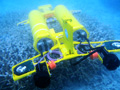
 Australian researchers have developed a low cost, miniature submarine for underwater research on ecosystems such as the Great Barrier Reef.
At around 25kg and 1.2 metres long, the Starbug, developed by the CSIRO ICT team in Queensland, Australia, is an autonomous underwater vehicle (AUV) small enough to be operated by one person from the shore, floating platform or small boat, without cranes or other specialised equipment.
Existing research submarines are power hungry and expensive to build and operate, and need to be tethered to a vessel so they are not lost. Human divers can only spend limited time under water and often work from research vessels which are expensive to operate.
Dr Matthew Dunbabin, leader of the Starbug team, looks forward to “platforms like Starbug to be deployed in large numbers to greatly improve data collection rates so that reef research can leap ahead."
Monitoring large areas necessitates large scale data collection, which is a challenge for Great Barrier Reef researchers.
Starbug is one of the first AUVs in the world designed specifically with vision as the primary sensor for navigation and control. So it does not need to be tethered and does not need an operator. Remote communication with Starbug occurs on the surface (eg GPS coordinates etc), and once the machine dives, it follows the mission control data that has been loaded onto the onboard computer. So it is “on its own” while it is under water. And so far, it has reliably popped back up on the surface as required.
Says Dunbabin, “The software has been developed over time to perform a variety of missions that are typical of those conducted by marine scientists. Many experiments have been conducted to verify and update software to ensure reliability. With no "life-line" to the surface, we want to make sure the vehicle returns home.”
“We have tried to make the operator interface as simple as possible. Using a set number of mission types, such as go from here to there at this depth then surface, the vehicle's on-board vision-based navigation system plans its own path and negotiates terrain and obstacles.”
"We chose vision for the navigation system due to its relatively low cost and its suitability for use in clear water, terrain-rich, reef environments. Furthermore, as marine researchers often need to acquire images, the same sensor can be used for navigation and image collection," said Dr Dunbabin.
Two cameras provide forward stereo images, with two more providing downward stereo images. These estimate distance to objects for odometry and obstacle avoidance, so the machine recognises obstacles in its path. The downward cameras are used to continually assess height above the sea floor. All processing is done on-board the vehicle.
The cameras also provide the visual record of the sea floor that is important to researchers, in a series of stereo still photographs.
"We are currently developing systems to allow Starbug to identify marine pests such as crown-of-thorns starfish based on their shape and texture. This will make it possible to accurately monitor population changes and design strategies for managing them."
Depending upon what kind of battery power is employed, missions can last from 3 to 8 hours.
Environmental monitoring may be its origins, but other applications such as offshore industry, pipeline survey, cable survey, detailed bathymetrics and port security are also being considered.
In its current form, the Starbug is designed for use at depths to 100m. Limitations include the available on-board energy storage and visability conditions. However, it can perform a number of purposeful missions in low-visibility conditions such as mid-water transects.